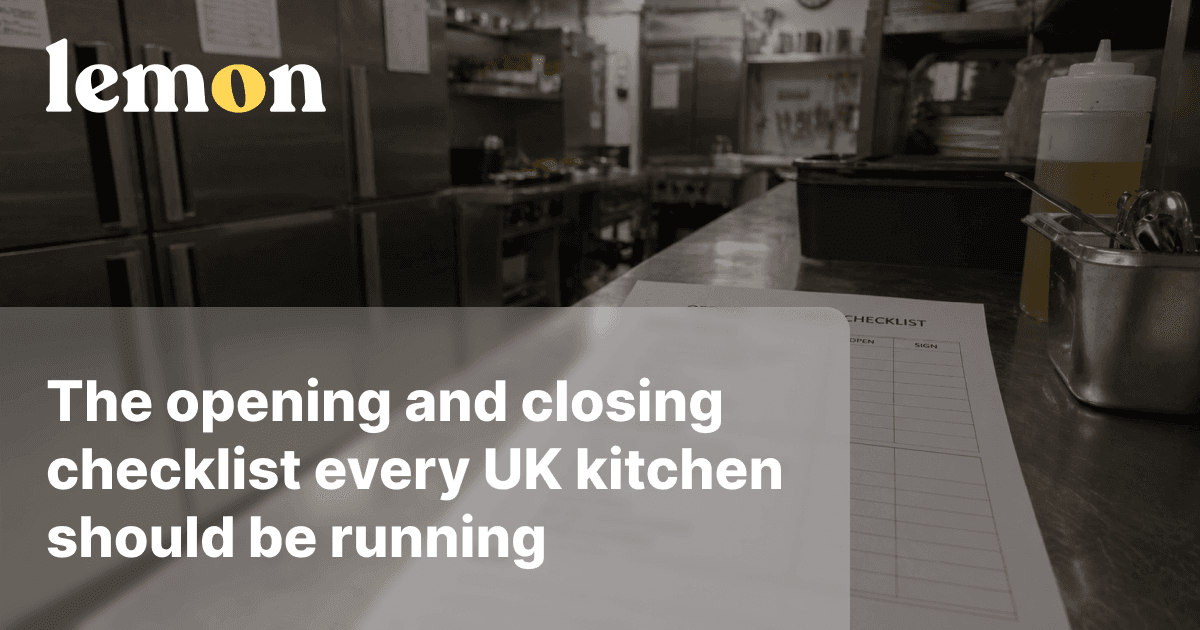
Every kitchen has an opening and closing routine. The good ones have it written down. The great ones have it written down, signed off every shift, and structured around the four things that will fail you in an inspection.
This is the working checklist we would give a new manager on day one. It is built around the FSA's “4 Cs” framework (Cross-contamination, Cleaning, Chilling, Cooking) plus a fifth bucket for documentation, and every item on it is here for a reason. Cut what does not apply to your operation, but do not cut what is uncomfortable.
Why this matters more than people think
Opening and closing checks are the part of food safety that most owners think they have under control and most inspectors find the gaps in. The pattern is always the same: the kitchen knows what should happen, the people doing it know what should happen, but on a Tuesday at 11 PM after a 14-hour shift, three items get skipped, nobody mentions it, and three months later it is “we always do that, just sometimes it does not get written down”.
A signed checklist is the thing that turns “we always do that” into “we did that, on this date, and here is the name of the person who did it.” That is the version that holds up in an inspection.
The opening checklist
Before you put a knife to a board, before the first delivery comes in, before anyone starts mise. Twelve items, ten minutes.
Temperature checks
FSA guidance starts at at least one fridge check a day. Lemon recommends opening and later checks so failures are found sooner. For the distinction, see how often you should check fridge temperatures.
- AM fridge readings. Every fridge, every undercounter, the walk-in chiller, the prep fridge. Probe reading where you can, door display where you cannot. Target 0 to 5 °C, legal max 8 °C. Out of range opens a corrective action.
- AM freezer readings. Walk-in freezer and any standalone units. Target at or below −18 °C.
- Hot hold up to temperature before any food goes in. At or above 63 °C, confirmed by probe.
- Probe calibration check if it is a calibration day. Boiling water (100 °C) and ice slurry (0 °C). Tolerance ±1 °C. Most kitchens do this weekly; some do it daily.
Cleaning and structure
- Visual walk-through of the kitchen and prep areas. Last night's cleaning sign-off matches what you are looking at? No surfaces missed, no equipment left dirty, no overnight pest activity (droppings, gnaw marks, disturbed bait stations).
- Hand-wash stations stocked. Soap, paper towel, hot water running. This is one of the two things an EHO checks within five minutes of arriving.
- Sanitiser made up to the right concentration. Quaternary ammonium or chlorine, made up fresh, dated.
Stock and prep
- Date check on stock in fridges. Anything past use-by gets pulled. Anything within 24 hours of use-by gets used today or pulled.
- Cross-contamination check on the walk-in. Raw on the bottom shelves, ready-to-eat on the top, nothing dripping onto anything. Allergen-segregated stock in its labelled containers.
Documentation
- Yesterday's records signed off. Did the closing team complete the closing checklist? Are there any open corrective actions from yesterday that need following up today?
- Today's allergen matrix matches today's menu. Specials added, anything off the menu removed.
- Sign and date the opening checklist. With your name. Not initials, not “head chef”. Name.
The closing checklist
This is the one that gets skipped. The closing team is tired, the head chef has gone home, and the diary is in the office. Build the closing routine to be doable in 15 minutes by one exhausted KP, or it will not get done.
Temperature checks
- PM fridge readings. Every unit. Same units, same targets. The PM read is the one that catches a fridge that has been failing through service.
- PM freezer readings.
- Hot hold reading at switch-off. Confirm the unit was holding temperature at the end of service, then turn it off.
Food safety
- All food appropriately stored or thrown. Cooked food cooled within 90 minutes (this means actively cooled, not “left out”), then into the fridge. Anything that has been hot-held for over the safe window is thrown.
- Cross-contamination check on the walk-in again. Same rules: raw bottom, ready-to-eat top, allergens segregated, everything covered, dated and labelled.
- Ready-to-eat items date-labelled with the date opened or made, and the use-by.
Cleaning
- Surfaces cleaned and sanitised. Boards, counters, slicer, mixer, anything that has touched food.
- Floor swept and mopped, including under equipment where you can reach.
- Bins emptied, internal and external. Lids closed.
- Hand-wash stations restocked for the morning.
- Sanitiser stations refilled or marked for fresh make-up tomorrow.
- Walk-in floor and door seals cleaned. This is the one that gets skipped, and it is the one where mould grows.
Use our restaurant cleaning schedule template to spell out the method, frequency and person responsible for each job.
Pest control and structure
- Doors closed, fly screens intact, no obvious pest entry points left open.
- No food residue at floor level, especially around dish-wash and bins.
Documentation
- Closing checklist signed and dated, by name.
- Any corrective actions logged with what happened and what was done. An honest log here is gold dust in an inspection.
The whole thing should take a competent closing team 20 minutes, parallel to wash-down. If it is taking an hour, the kitchen layout is probably working against you.
The 4 Cs, why each item is on the list
If you ever need to defend a checklist item to a sceptical chef (“why am I doing this?”), the 4 Cs are the framework.
- Cross-contamination. Items 9, 5, 8, 12, 14 (closing). Stops raw chicken juice from being on the same surface as the salad. The single biggest cause of food poisoning prosecutions in the UK.
- Cleaning. Items 5 to 7 (opening), 7 to 12 (closing). Reduces bacterial load on contact surfaces. Boring, essential, the one everyone underdoes.
- Chilling. Items 1 to 3 (opening), 1 to 4 (closing). Stops pathogen growth. The stuff this article is mostly about.
- Cooking. Not on the open/close checklist directly, lives in the food log. Cook to 75 °C core (82 °C in Scotland). Reheat once, to the same target.
Plus the fifth bucket nobody talks about:
- Confidence in management. Everything to do with documentation. The reason inspections go well or badly, and the score most owners misunderstand (we covered it in what an EHO actually looks for).
Making it stick
Three things make a checklist actually run, every shift, for years:
- Build it into existing routines. The opening reading happens before the first coffee. The closing reading happens before the lights go off. Do not make it a separate exercise that has to be remembered.
- Make it positional, not personal. “The opening chef does opening checks” beats “Sam does opening checks”. Sam is not there forever.
- Sign by name, every time. Initials are easy to forge. Names are not. More importantly, names create accountability, and accountability is what makes the check actually happen instead of being signed off blind.
Most paper checklists fail on item 3. They get signed off in batches, which inspectors notice, which kills your confidence-in-management score.
How to run this in practice
You can absolutely run an opening and closing routine on paper. Keep a clipboard by the door. Print this list, laminate it, sign it twice a day. The downside is that paper is also where these checklists go to die: lost pages, damp diaries, retroactive sign-offs.
A phone-based version of this lives inside Lemon. The opening and closing checklists are pre-loaded, the temperature checks are built in with target ranges per unit, every entry is timestamped at the moment it is recorded, and the whole month is exportable as a PDF when the inspector asks. Custom checklists let you add the items specific to your kitchen (fryer-oil change, specials prep, deep-clean rotation). Around 900 UK kitchens run their open and close on it, and have recorded over 400,000 checks between them. The 14-day trial does not need a card.